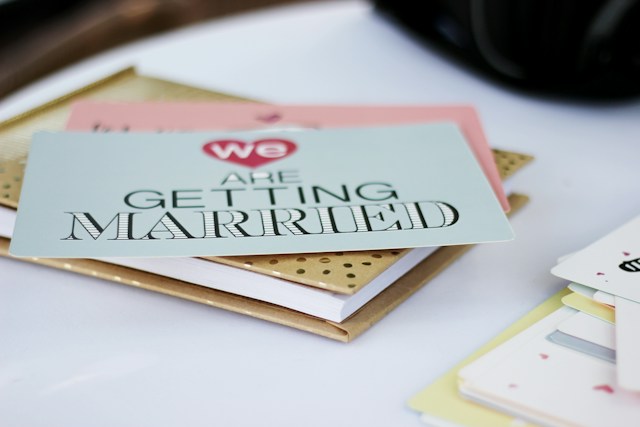
Wedding planning has a way of turning “just send some invitations” into a spreadsheet with fourteen tabs. Stationery is one of those categories that looks simple until you’re three months out and realize you never ordered thank-you cards, your RSVP deadline is too close to your final headcount deadline, and you haven’t written a single word of your vows. Here’s a full rundown of what belongs on your wedding stationery checklist — and when to actually tackle each piece.
Start With the Big Three
Every wedding stationery suite is really built around three moments: telling people the wedding is happening, finding out who’s coming, and giving guests what they need once they arrive.
Save-the-dates go out first, ideally 6–8 months before the wedding (longer for destination weddings). They don’t need details — just names, a date, and a “formal invitation to follow.”
Invitations follow 6–8 weeks before the wedding, and this is where your RSVP cards come in. Your RSVP set should include a response card with a clear deadline, and if you’re serving a plated meal, a spot for guests to mark their entrée choice. Give yourself at least 3–4 weeks of buffer between your RSVP deadline and the date your caterer needs a final headcount — that buffer is what saves you from a last-minute scramble.
Day-of materials — programs, menu cards, place cards, table numbers — usually get ordered last, once your final guest list and seating chart are locked.
The RSVP Piece Deserves Its Own Plan
RSVPs are the most functional item on this list, and also the one people most often mess up. A few things worth deciding early:
- Paper or digital? A physical RSVP card feels traditional and photographs well, but a QR code or wedding website RSVP is faster to track and easier to follow up on. Plenty of couples do both: a paper card for the aesthetic, with a QR code as backup.
- Wording matters. “Kindly respond by [date]” reads differently than “We can’t wait to celebrate with you — RSVP by [date].” Match the tone to the rest of your invitation suite.
- Track responses as they come in, not in a last-minute pile the week before your deadline. A simple spreadsheet with names, meal choices, and plus-ones will save you real stress later.
- Expect stragglers. No matter how clear your deadline is, someone won’t respond on time. Build a few days of padding into your internal timeline so you’re not calling guests the night before your catering deadline.
Vow Books: The One Item That’s Just for You
Here’s where stationery stops being about your guests and starts being about the two of you. A vow book isn’t functional in the way an RSVP card is — nobody but you and your partner will ever read it — but it’s often the item couples end up treasuring most.
If you’re writing your own vows, a dedicated wedding vow book gives you a place to draft, revise, and eventually keep them, rather than reading off a phone or a piece of paper that gets lost in a jacket pocket by the reception. Many couples order matching “his and hers” (or hers and hers, his and his) vow books so the keepsake matches on both sides. Others tie them into the same color palette or paper stock as the rest of their stationery suite, so the whole collection feels intentional rather than assembled piecemeal.
If you’re stuck on what to actually write, prompts help: What did you notice about your partner early on that you still notice now? What does a hard day look like when they’re there for it? What are you promising, specifically — not just “always love you,” but what that actually looks like day to day. A vow book with structured prompts can make the blank-page problem much less intimidating.
Don’t Forget the Follow-Up
One piece people consistently forget: thank-you cards. Order these at the same time as your invitations so they match, even though you won’t send them until after the wedding. Trying to source matching thank-you cards two months post-wedding, after the shop has moved on to a new season’s designs, is a frustration entirely avoidable with one extra line item now.
A Simple Order of Operations
- Save-the-dates — 6–8 months out
- Invitations + RSVP cards — 6–8 weeks out, matched to a deadline with buffer before your caterer’s cutoff
- Vow books — anytime, but give yourself at least a few weeks before the wedding to actually write
- Day-of stationery — once your headcount and seating are final
- Thank-you cards — ordered early, sent after the wedding
Stationery isn’t just paper — it’s the timeline of your wedding, made physical. Getting the RSVP logistics right keeps your planning on track; taking the time with something like your vow book is what makes the day feel like yours. Plan for both, and you’ll spend less time stressed about deadlines and more time actually looking forward to what you’re going to say when you get up there.
















Speak Your Mind